Custom Spout Pouch Guide
Spout Bore Size: Choosing the Opening on a Spout Pouch
Bore is decided by how the product leaves the pouch — squeezed, poured or pumped. A short guide to the number, and why it locks the cap and the tooling.
Spout Bore Size: Choosing the Opening on a Spout Pouch
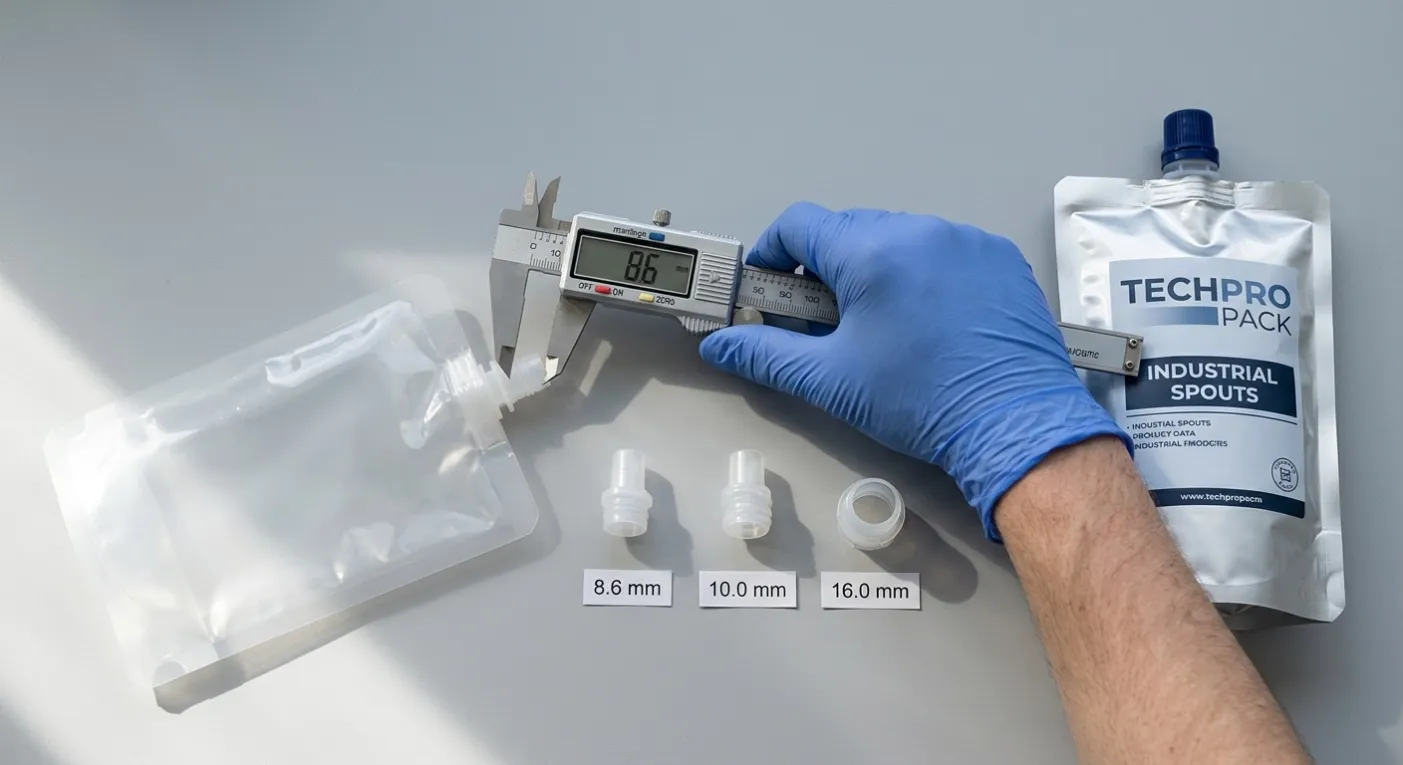
The bore is decided by how the product leaves the pouch, not by how much the pouch holds. Squeezed out, a small bore. Poured, a mid bore. Pumped or tapped, whatever neck the pump has. Everything else on this page follows from that sentence.
1. Four ways a product leaves a pouch
Squeezed. Lotion, gel, cream, paste, thick sauce. The customer points and squeezes, and the product should come out as a ribbon they can control. A small bore does that. Widen it and the same squeeze delivers a lump.
Poured. Water, oil, shampoo, detergent, juice — anything thin enough to run. Here the bore is limited by air rather than by liquid: what leaves has to be replaced by air going back in, and a narrow bore on a thin liquid glugs, splashes and stops halfway.
Poured in volume. Concentrate, syrup, a 5 litre refill. Wide bore, and the cap becomes the measure — the customer fills a cap, not a teaspoon.
Pumped or tapped. A dispenser head, a tap, a pump on a 10 litre bag. The bore follows the fitting, and the pouch's job is to hold that fitting without leaking at the weld.
2. Two numbers that get missed
The filling head. The nozzle has to enter the bore. A bore chosen for how the pack looks on a shelf can be too tight for the line, and then every pouch on that order fills slowly — or the line fills through a different opening and the spout exists only for the customer. Ask your filler what it needs before you approve artwork.
The dose. On food, baby food and concentrates, the bore sets how much leaves the pouch in one movement. A wide bore on a 90 g baby food pouch gives the parent more than the child eats, twice over. This is why a food pouch and a cosmetic pouch do not share a bore even at the same volume.
3. Bore, cap and tooling are one decision
Change the bore and you have changed the cap, screw, flip-top or pump cap,and the die that welds the spout into the bag. Tooling is one-off and quoted separately, so a bore change after approval means a new die and a new sample round. It is the one number worth settling before the artwork rather than after.
4. What to send us
- What the product is, and how thick it is. "Like water", "like shampoo", "like toothpaste" is enough.
- How the customer gets it out: onto a hand, into a cap, into a bottle, through a pump.
- Your filling nozzle diameter, if you already have a line.
- Whether it is food or baby food, because the dose matters there.
Those four are enough to answer with one bore rather than a range.
FAQ
No. Leaks come from the seal around the spout base and from the cap gasket, not from the size of the hole. A wide bore with a poor gasket leaks; a narrow one with a good gasket does not. If you are chasing a leak, the bore is the wrong place to look.
Can the same bag take two bore sizes?
Not from the same die. The weld area is sized to the spout base, so a different spout means a different die even when the bag itself is unchanged.
Is the bore the same as the cap diameter?
No. The bore is the hole. The cap's outside diameter is larger, and the cap is specified by the bore it fits — two caps of different heights can sit on the same bore.
Order parameters
Item | What we work to |
|---|---|
Bore | Chosen from the product and the fill line; common sizes on existing tooling, others tooled |
Cap | Screw, flip-top or pump, matched to the bore |
Capacity | 100 ml–5 L standard; 3–10 L with handle |
Bulk MOQ | 50,000 pcs per size |
Trial run | 1,000 pcs |
Lead time | Confirmed against the production schedule, not estimated |
Send the product, the way it leaves the pack and your filling nozzle, and we will answer with a bore and a cap rather than a list.