Custom Spout Pouch Guide
Sourcing Spout Pouches From China: Sample to Shipment
Most first orders fail in four places nobody wrote down: how quantity is counted, what a sample approves, who holds the tooling, and when the ship date was fixed.
Sourcing Spout Pouches From China: Sample to Shipment
Most first orders do not fail on price, and they do not fail on quality. They fail in four places where nobody wrote anything down: how quantity is counted, what an approved sample actually approves, who holds the print cylinder, and when the ship date was fixed. Close those four and the order runs itself. The rest of this page is the order, in sequence.
1. Before you send the enquiry
A quotation is only as good as the information behind it. Nine fields decide it(the nine fields that make a quote accurate): capacity, the product going in, film structure if you already have one, print colours, cap type, quantity per design, artwork readiness, the market you sell in, and whether the bag has to survive retort or freezing.
Leave three out and the price that comes back is for a different bag. The one most often missing is quantity per design, because quantity is counted per design, not per order. Bulk starts at 50,000 pieces per size, and each size is its own design — a 250 ml and a 500 ml in the same print are two minimums, not one.how MOQ is counted per design
2. Three samples, three different questions
Buyers say "a sample" as if it were one thing. It is three, and they do not answer the same question.
Sample | Speed | What it settles | What it cannot |
|---|---|---|---|
Stock | Days | Shape, spout, whether the pack suits the product | Anything about print |
Digital short run | Days to a week | Artwork on a bag, layout, colour direction | Final colour; the film may not match the run |
Production | Weeks | Colour, seal and shelf appearance, together | Nothing — this becomes the reference |
Most first orders need the stock sample and the production sample. The middle one earns its place when the artwork is still being argued about internally.
3. Artwork and tooling: what you pay for once
Send vector — AI, PDF or EPS — text converted to outlines, CMYK, 300 dpi for any placed image, with the seal area and the spout area left clear. A pouch is not a flat sheet: the face curves into the side gusset and into the seal, and anything printed near those edges distorts. Safe area is confirmed per size; there is no universal template.
Print cylinders and shaped dies are one-off tooling, quoted separately from the bags because the order does not consume them — they sit and wait for your next run. Two questions to ask before you approve: who holds the tooling(how to judge the factory behind the quote), and can it be transferred if you move. Put both answers in writing, not in an email thread.
A shaped pouch — a heart, a bottle outline, a die-cut handle — needs its own die, tied to one outline at one size. Move the size by 20 mm and it is a new die.
4. What approval covers
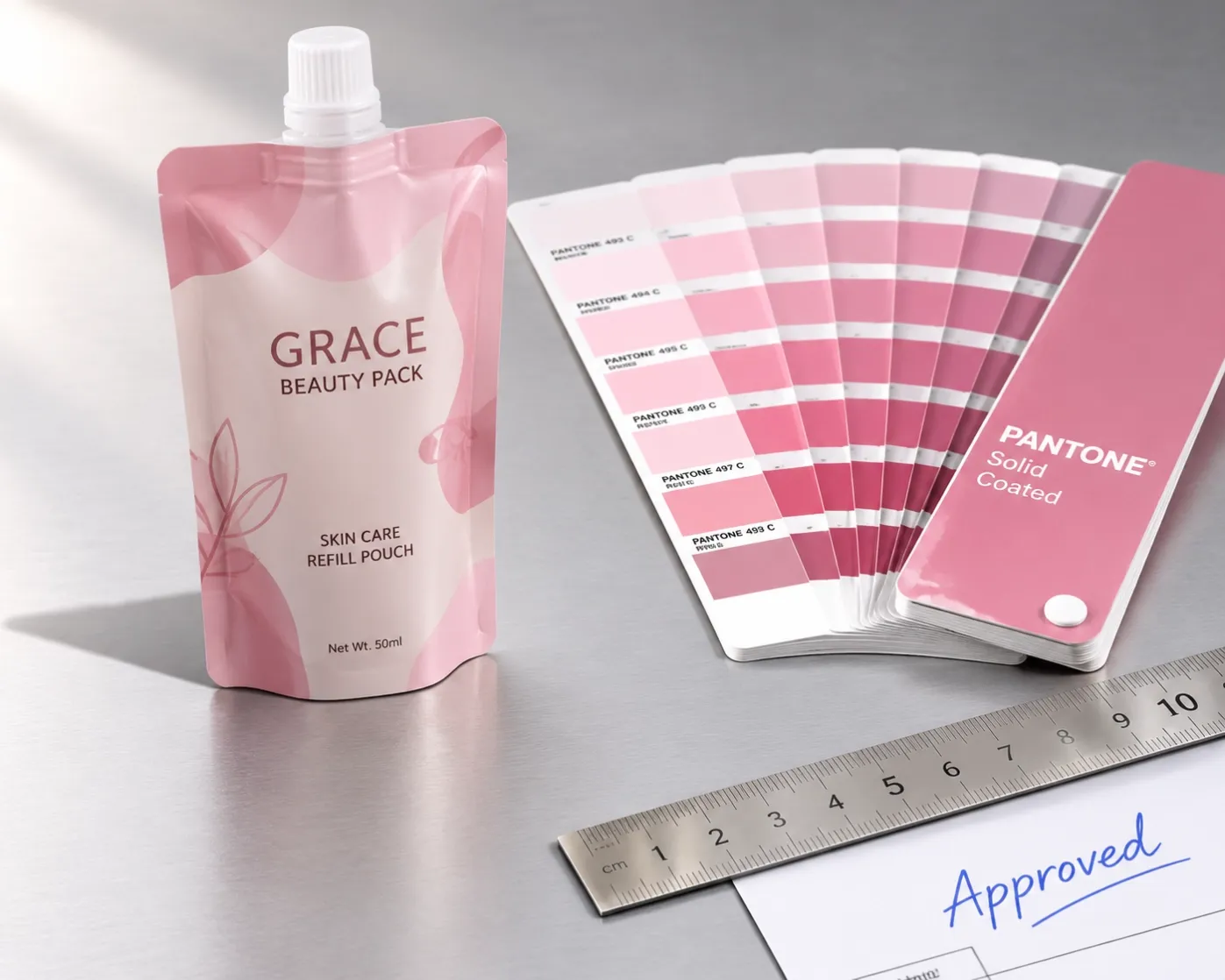
Signing off a production sample approves four things: the film structure, the print colour, the bag dimensions, and the spout and cap. Not three of them, and not "the look of it". Colour agreed by eye on a phone screen is not approved — see it on the sample, in daylight, and keep that sample.
5. Three dates, and one sample before it ships
You do not need to stand in the factory. You need three dates: when production starts, when the bags are packed, and when they leave. A supplier who can only give you one date at the end is telling you that you will hear about the delay after it has cost you the container.
Then, before it ships, ask for a sample from the actual run rather than from the approval batch. Check the seal, how the spout turns, and where the print sits against the seal. A bag that passed at approval can still fail here if the film roll changed.
6. Documents and terms
A normal shipment carries a packing list, a commercial invoice and a bill of lading. Food, beverage and baby-food pouches also need a food-contact declaration, and often a migration test report for the destination market.
Three terms cover most first orders. EXW — you collect from the factory and control everything after. FOB — the supplier clears export and loads, your forwarder takes it from the port. DDP — delivered to your door with duty paid: simplest on paper, and the one where you stop seeing what the freight actually cost.
7. Money
Most factories work on a deposit with the balance against a copy of the bill of lading. That protects both sides: you keep leverage until the goods are on the water, and the supplier is not financing your order. Paying in full before production gives that up for nothing, and a supplier who expects a second order rarely asks for it.
8. The order file
One page, agreed before you pay. If it is not on this page, it is not agreed.
Written down | Why it is there |
|---|---|
Quantity per design, in pieces | 50,000 per size; each size is its own design |
File format accepted: vector, outlined | A JPEG approves nothing |
Colour reference and the retained sample | The sample is the reference, not the memory |
Tooling: cost, holder, whether it transfers | Decided once, before the die is cut |
Not from the filling machine's convenience | |
Three dates: production, packing, departure | One date is not a schedule |
Incoterm, and what it includes | DDP hides the freight line |
Payment: deposit, balance against B/L copy | Not full payment before production |
Everything above this table explains why each line is on it. Nothing on it needs a lawyer, a consultant or a second trip.
FAQ
How long does a first order take?
Three clocks run at once: artwork and tooling, the sample round, and the production slot. You control the first two; the third is booked. Ask at quotation stage which dates are already held, and get the production date in writing before you pay.
Can I order less than 50,000?
A trial run of 1,000 pieces per size exists for that. It is a trial, not a small bulk order — the point is to fill and test the bag, not to launch with it.
Can the bag take hot filling?
Retort-grade structures are built for 121 °C. Whether you need one is set by your fill temperature and by whether the product is retorted after filling, not by the product category. Tell us the fill temperature and we will name the structure.
Can I put my logo on a stock bag?
Yes, but printing needs a cylinder, and a cylinder needs a design that will not change. If the artwork is still moving, wait.
What if the colour is wrong on arrival?
That is what the approval sample is for: it becomes the reference for every later batch. Which is why colour confirmed on the actual film, and kept, matters more than colour confirmed quickly.
Order parameters
Item | What we work to |
|---|---|
Capacity | 100 ml to 5 L |
Film structure | PET/PE, PET/AL/PE, PET/AL/PA/PE, mono-PE |
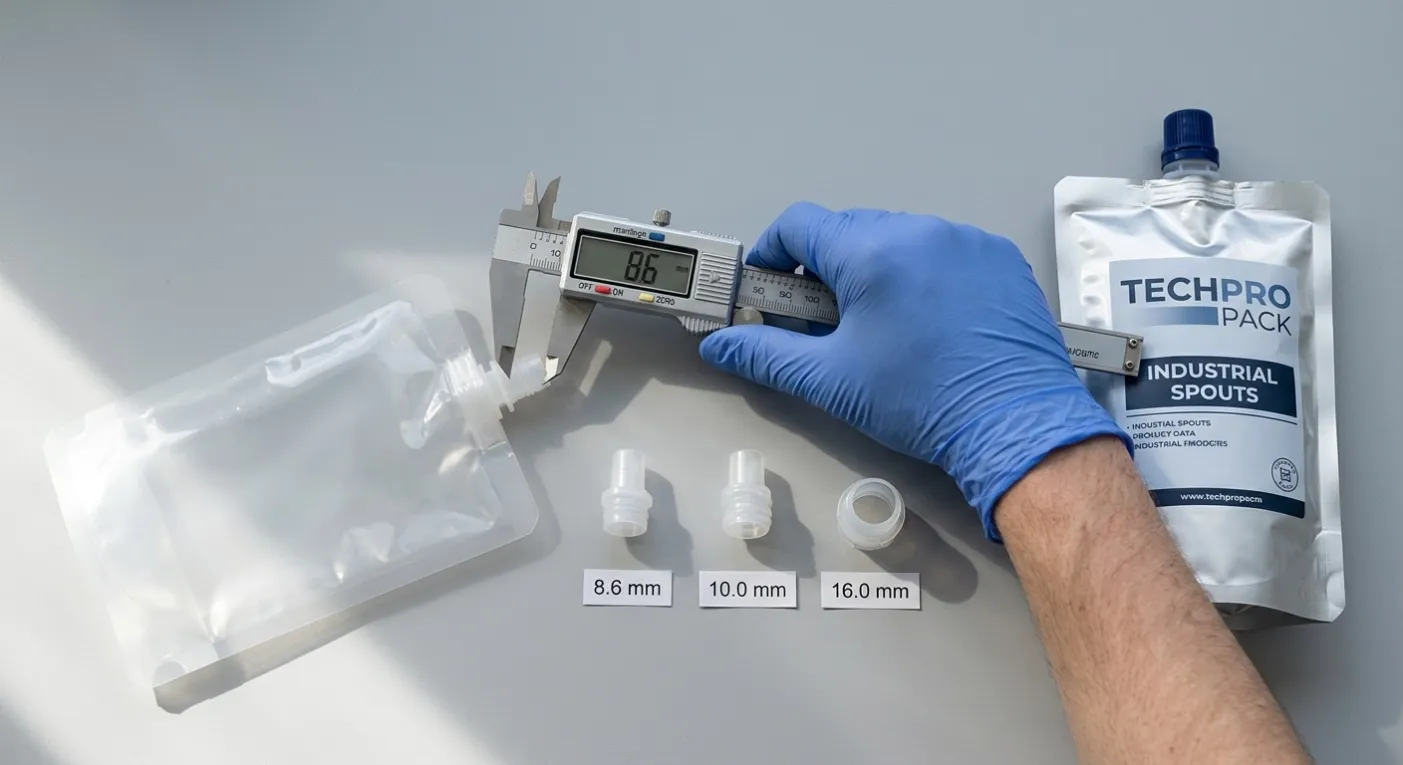
Spout | Bore chosen by product thickness; screw, flip-top or pump |
Bulk MOQ | 50,000 pcs per size |
Trial run | 1,000 pcs |
Tooling | Cylinders and dies quoted separately, held for repeat runs |
Print | Colour count confirmed against the design |
Lead time | Confirmed against the production schedule, not estimated |
Send the product, the capacity, the artwork status and the quantity you are planning per design, and we will come back with the structure, the spout and a production date.