Custom Conditioner Refill Spout Pouch for Hair Care Brands
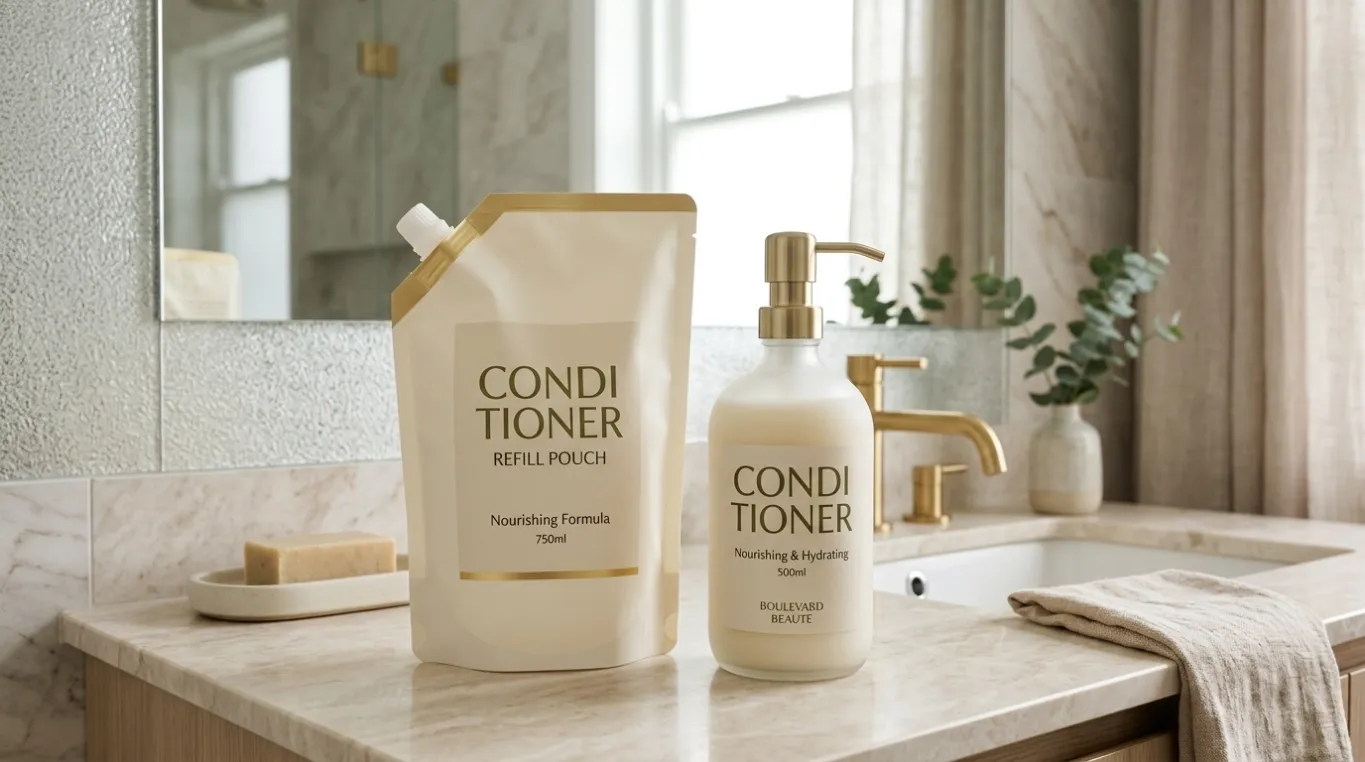
Refill pouches for conditioner and hair mask, with a wide bore for thick product and a shape that empties clean. Custom print, MOQ 50,000 pcs.
Specifications
- Product Type
- Conditioner Refill Spout Pouch
- Application
- Conditioner, hair mask, hair treatment, leave-in cream
- Capacity
- 250 ml – 1 L (custom)
- Pouch Type
- Stand-up spout pouch, corner spout option
- Material
- PET/PE · mono-PE · PET/AL/PA/PE on request
- Spout
- Wide bore for high-viscosity product (16 mm flip cap option)
- Cap
- Screw cap / flip cap
- Printing
- Gravure, customer-supplied artwork
- Finish
- Matte / glossy / soft-touch
- MOQ
- 50,000 pcs per size
- Trial
- 1,000 pcs, one design
- Samples
- Free stock samples; printed samples 7–10 days
- Production
- 15–20 days after deposit and artwork approval
- Certification
- ISO 9001, ISO 22000
Conditioner Refill Spout Pouch
Conditioner does not pour. It moves when the pouch is squeezed, and it stops moving when the customer stops squeezing — which means the pack is judged on how much comes out per squeeze, and on how much is left behind at the end.
These are stand-up spout pouches from 250 ml to 1 L for conditioner, hair mask and leave-in treatment, printed with your artwork. Bulk MOQ is 50,000 pcs per size, with a 1,000-pc trial.
Thick product needs a wider bore, not a bigger cap
The instinct when a product will not come out is to open up the cap. That is the wrong end of the problem: the cap is the lid, the bore is the restriction, and the bore is what sets the force the customer has to apply.
A narrow bore on a conditioner is not a slow pour, it is a hard squeeze. The customer squeezes, nothing happens, squeezes harder, and then gets a lump. That lump is the review. The bore is chosen from how the product leaves the pack, and for anything thick that means wider than the shampoo in the same range.
The cap decides how it leaves the pouch, not just how it closes
Three closures are used on conditioner pouches, and the choice follows how the pack is used rather than what it costs. A flip cap on a 16 mm spout is the salon refill and travel-size answer: it opens with a thumb, it does not get lost, and a wide mouth passes thick product without clogging. A screw cap suits a larger refill that is poured rather than squeezed. A pump is the back-bar answer — the pouch sits on a basin and is pressed one-handed.
What does not change is the bore underneath. A flip cap on a narrow spout still cannot pass conditioner, so the cap and the spout are specified together, never one after the other.
The last third is where refills get criticised
Every refill pouch has a point where it becomes awkward, and for a thick product that point arrives earlier — around a third left, when the product can no longer reach the spout without being pushed.
Two design levers move that point. A corner spout lets the pouch be tipped further before the product has to travel uphill, and a pouch that stands on a wide base can be rolled or pressed flat against a surface to chase the last of it. Neither fixes the problem completely; both decide whether the last third is a complaint or a non-event.
It is worth testing on a sample, filled with something of a similar thickness and left until a third remains. The question is not whether product is left, it is whether the customer can get it out without scissors.
Oils and silicones put the seal under different load
Conditioner carries oils, silicones and fragrance at higher levels than shampoo, and those components behave differently at a seal: they wet it, they migrate slowly, and over a long shelf life they can soften an adhesive that was fine on day one.
This is a structure question rather than a spout question, and it is answered by testing the finished pouch filled with the real formula rather than with water. A six-week acceleration on a pouch filled with the actual product is the cheapest test in the project and the one most often skipped.
Salon and back-bar formats
A one litre pouch with a pump is a back-bar format: it sits on a basin, it is used many times a day, and it is refilled from a larger container rather than replaced. That changes the requirement — the pump has to survive repeated use, and the pouch has to be stable enough to be pumped one-handed without sliding.
Retail refill and back-bar are two different packs with the same print, so say which one you are making before the artwork. The hair care refill format covers the wider range if you are planning several SKUs at once.
MOQ, samples and the first run
Bulk MOQ is 50,000 pcs per size, and each capacity is its own size — 250 ml and 500 ml in the same print are two minimums. A 1,000-pc trial is available before a full run.
Stock samples ship free. Printed samples take 7–10 days; production runs 15–20 days from artwork approval and deposit. If the formula is unusually thick, send a sample of the product itself — the empty-pouch test will not show how it behaves at the spout.
What to send for a quotation
- the viscosity, or simply the product type — conditioner, mask, leave-in
- how the customer uses it: into a hand, into a bottle, through a pump
- whether it is retail refill or back-bar
- artwork status, and whether the pack carries a fragrance claim
Those four decide the bore, the cap and the pouch shape. Everything else is print.
FAQ
Will a wider bore make it leak?
No. Leaks come from the seal around the spout base and from the cap gasket, not from the size of the hole. A wide bore with a good gasket holds; a narrow one with a poor gasket does not, whatever the diameter.
Can the same pouch take a pump and a screw cap?
Not from the same spout. The pump neck and the screw thread are different interfaces, so the spout is specified for one or the other — the pouch body can be identical, the spout cannot.
Is a corner spout worth it?
For thick product, usually yes. It lets the pouch be tipped further before the product has to travel uphill to the spout, which is the difference between a usable last third and a wasted one. For a thin product the benefit is smaller.
Get a quotation
Send the product type, the viscosity and the way it leaves the pack, and the reply is a bore and a spout position rather than a list. Send your specification and we will answer in one message.