Sep 1, 2026Packaging Materials & Printing Guide
PET vs PE Spout Pouches: How to Choose the Right Material
Compare PET and PE spout pouches to choose the right material for your product. Learn about durability, barrier performance, appearance and suitable applications.
PET vs PE Spout Pouches: How to Choose the Right Material
Choosing the right material is an important step when developing custom spout pouch packaging. PET and PE are commonly used in flexible pouch structures, but they serve different functions depending on the product, barrier requirements and packaging design.
The best choice depends on more than appearance. Product compatibility, filling conditions, shelf life and distribution should all be considered.
1. What Is PET in Spout Pouch Packaging?
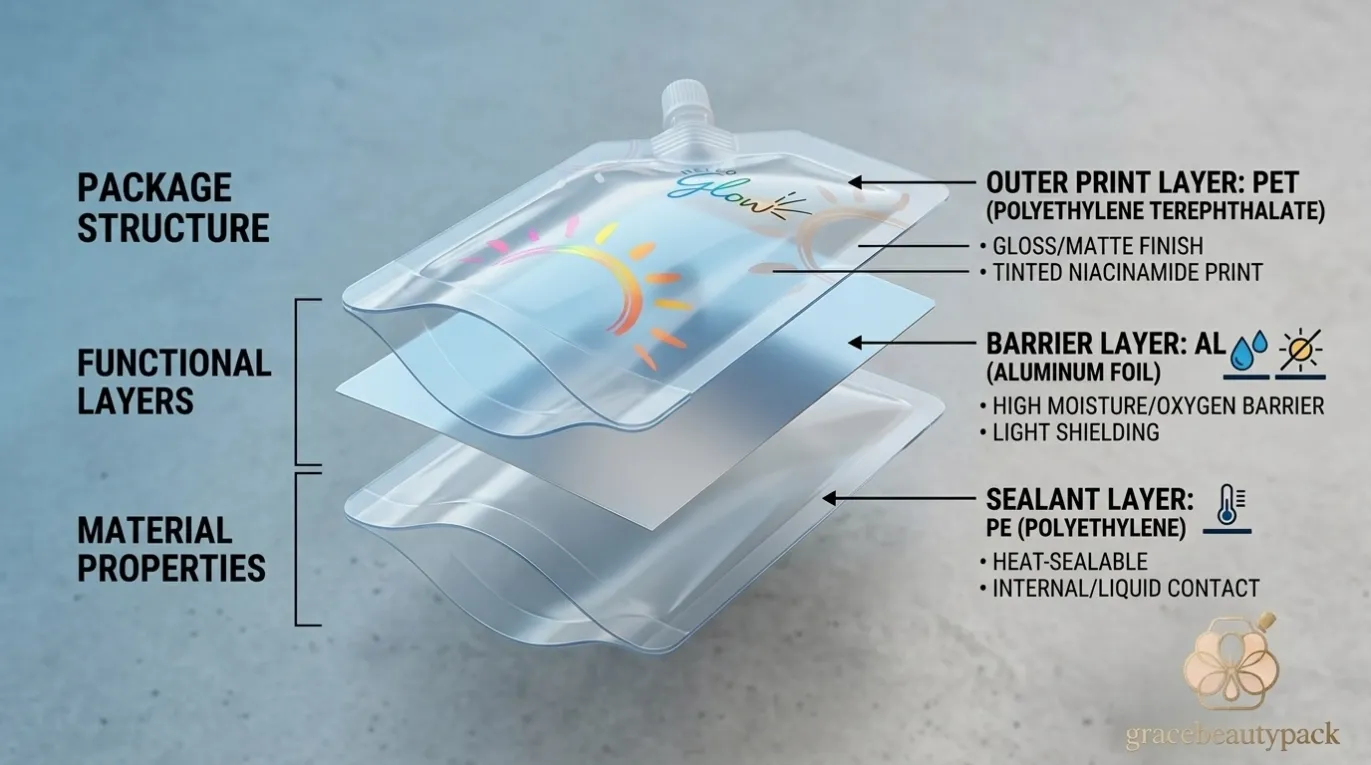
PET, or polyethylene terephthalate, is commonly used as an outer layer in laminated flexible packaging.
It provides:
- Good printability
- High stiffness and dimensional stability
- A smooth surface for branding
- Good resistance during handling
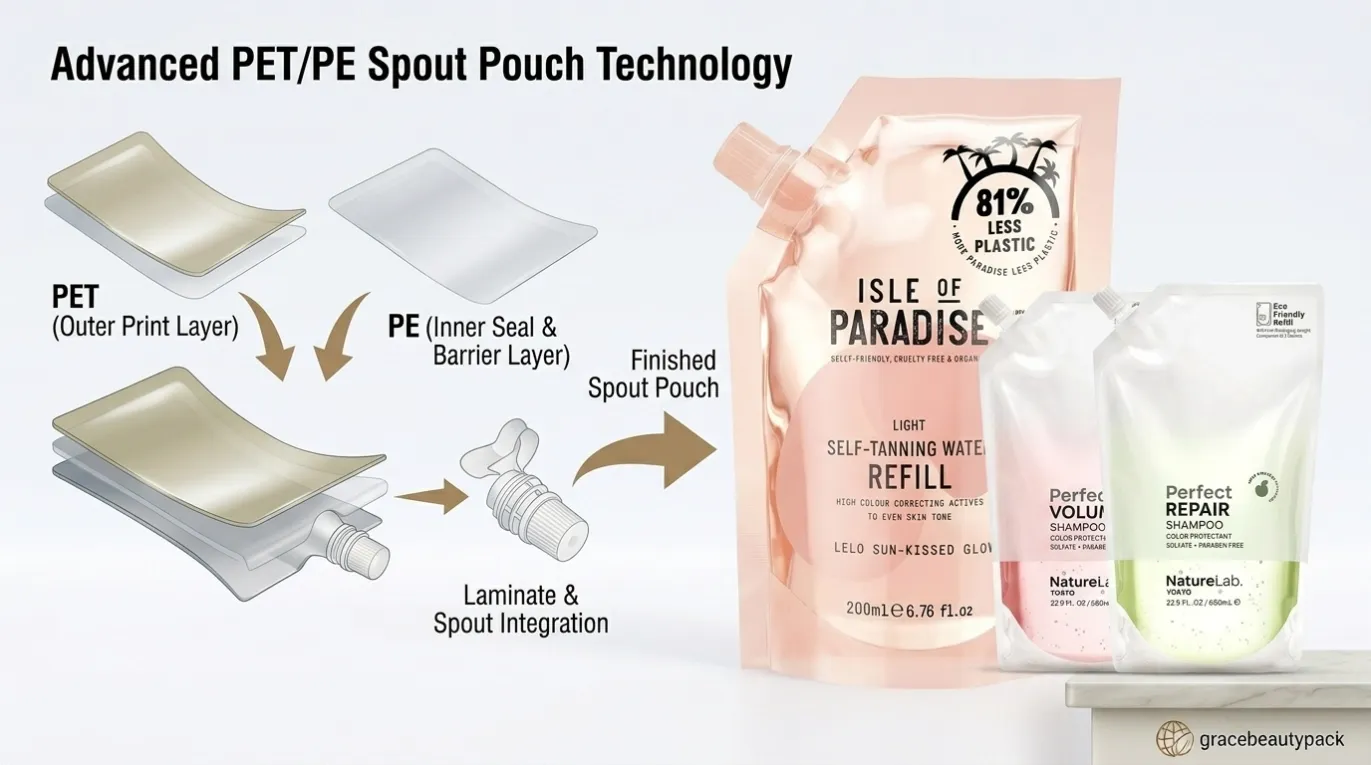
PET is often combined with PE or other layers rather than used alone as the complete pouch structure.
For brands that prioritize high-quality printing and a more structured pouch appearance, PET-based structures can be a practical option.
2. What Is PE in Spout Pouch Packaging?
PE, or polyethylene, is widely used as a sealant layer in flexible packaging.
Its key functions include:
- Heat sealing
- Flexibility
- Good toughness
- Compatibility with many liquid products
PE can also be used in mono-material structures, such as Mono-PE packaging, for brands exploring recyclable flexible packaging options.
The exact PE grade and structure should be selected according to the product and production requirements.
3. PET vs PE: Which Is Better?
There is no single material that is best for every spout pouch.
Factor | PET-Based Structure | PE-Based Structure |
|---|---|---|
Printability | Excellent | Good |
Stiffness | Higher | More flexible |
Heat sealing | Usually combined with sealant layer | Excellent |
Flexibility | Moderate | High |
Branding surface | Excellent | Good |
Recyclable structure options | Depends on structure | Mono-PE options available |
In many commercial pouches, PET and PE work together rather than being competing materials.
The final structure may combine several layers to balance printing, strength, sealing and product protection.
4. When Should You Consider a PET/PE Structure?
PET/PE is a practical structure for many general liquid and semi-liquid products.
It can be considered for applications such as:
- Shampoo
- Conditioner
- Body wash
- Liquid soap
- Household cleaners
- Some food products
The PET outer layer provides a suitable printing surface, while the PE inner layer provides the sealing function.
For many standard applications, this combination offers a useful balance between performance, appearance and production practicality.
5. When Is a Higher-Barrier Structure Needed?
Some products require stronger protection from oxygen, moisture or light.
In these cases, a higher-barrier laminated structure may be more appropriate.
Examples include:
- PET/AL/PE
- PET/AL/PA/PE
- Other customized barrier structures
Aluminum and additional functional layers can improve protection for products with more demanding shelf-life or light-barrier requirements.
The required structure should be determined based on the formula and expected storage conditions rather than selected only for marketing purposes.
6. What About Mono-PE Spout Pouches?
Mono-PE structures are becoming an option for brands looking to simplify flexible packaging materials.
A Mono-PE pouch can potentially support recycling-oriented packaging strategies, depending on the actual structure, local recycling infrastructure and applicable requirements.
For brands considering Mono-PE, it is important to evaluate:
- Product compatibility
- Seal performance
- Barrier requirements
- Mechanical strength
- Printing requirements
- Target-market recycling systems
Sustainability goals should be considered together with actual packaging performance.
7. How Should Buyers Choose the Material?
Before selecting a spout pouch material, buyers should answer several questions:
What is the product?
Liquid, gel, cream or another formula?
Does it need light or oxygen protection?
If yes, a higher-barrier structure may be required.
How long is the expected shelf life?
Longer shelf-life requirements may influence barrier selection.
What is the target market?
Recycling requirements and packaging regulations vary between markets.
What appearance is required?
Printing quality, gloss, matte finishes and pouch stiffness may influence the outer material.
8. Choose the Right Spout Pouch Material
PET and PE should not simply be viewed as two competing materials. In flexible packaging, different layers often work together to provide the required printing, sealing, strength and barrier performance.
Grace Beauty Pack can develop custom spout pouch structures based on product type, capacity, dispensing requirements and packaging objectives.
For a material recommendation, contact us with your product type, filling volume and key packaging requirements.