Sep 20, 2026Custom Spout Pouch Guide
How to Choose the Right Spout Pouch Size for Your Product
Learn how to choose the right spout pouch size based on product type, filling volume, pouch dimensions, spout position, usage requirements and shipping needs.
How to Choose the Right Spout Pouch Size for Your Product
Choosing the right spout pouch size is important for product usability, filling efficiency, transportation and overall packaging cost. A pouch that is too small may not provide enough capacity, while an oversized pouch can increase material usage and shipping volume.
For brands developing custom spout pouch packaging, the right size should be selected based on the product, filling volume, dispensing requirements and end-use scenario.
1. Why Spout Pouch Size Matters
Spout pouch size affects more than just how much product the package can hold.
The pouch dimensions can influence:
- Product capacity
- Filling efficiency
- Dispensing performance
- Storage and transportation
- Shelf presentation
- Material usage
- Shipping costs
- Customer handling experience
For this reason, brands should determine the required pouch size before finalizing the packaging structure and artwork.
2. Choose the Size Based on Product Type
Different products require different pouch capacities and dimensions.
Cosmetic Products
Small spout pouches can be suitable for cosmetic samples, travel-size products, liquid makeup and other lightweight applications.
For products such as liquid foundation, lip products or skincare formulas, brands should consider both the fill volume and the ease of dispensing through the selected spout.
Shampoo and Hair Care Products
Shampoo, conditioner and hair treatment products are commonly packaged in medium- to large-capacity spout pouches.
A larger pouch can provide sufficient product volume while maintaining a convenient dispensing format for refill applications.
Liquid Detergent and Home Care Products
Laundry detergent, dish soap and other liquid home care products often require larger capacities.
The pouch should provide enough space for the required fill volume while maintaining sufficient strength during transportation and daily use.
Baby Food
Baby food pouches require careful consideration of capacity, opening size and dispensing convenience.
The pouch size should match the child's serving size or the intended consumption format while allowing the product to be filled and dispensed efficiently.
Food and Beverage Products
Sauces, condiments and other liquid or semi-liquid foods can use different pouch capacities depending on the application.
For example, single-use products may require compact packaging, while family-size products need larger capacity.
3. Consider Common Pouch Capacities
There is no single standard size suitable for every product.
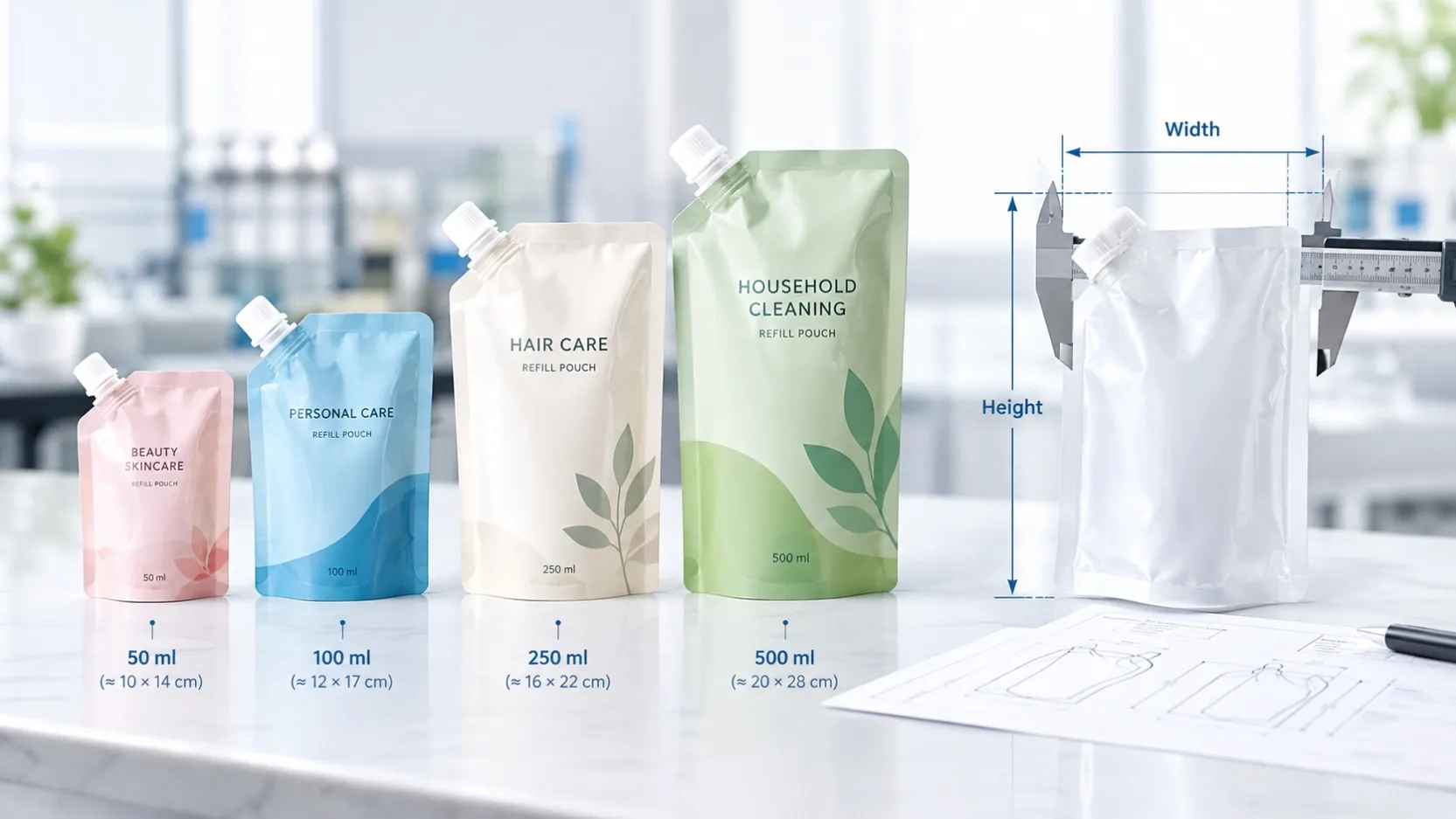
Depending on the application, custom spout pouches can be developed for:
- Small sample and trial sizes
- Travel-size products
- Single-use products
- Refill packaging
- Regular consumer sizes
- Family-size products
- Commercial or larger-volume applications
The actual pouch dimensions should be determined according to the product's density, filling volume, headspace and packaging structure.
4. How to Choose Pouch Dimensions
When selecting dimensions, brands should consider more than the stated capacity.
Fill volume:
Determine how much product the pouch needs to contain.
Product density:
Two products with the same volume may have different weights and filling characteristics.
Headspace:
The pouch needs appropriate space for filling and sealing without compromising package performance.
Product viscosity:
Thicker products may require a different pouch and spout configuration from low-viscosity liquids.
Pouch structure:
Material thickness and laminate structure can affect the final pouch dimensions and flexibility.
5. Spout Position Also Affects Usability
The spout should be positioned according to how consumers will use the product.
For example:
- Top spouts can work well for products designed to be stored upright.
- Corner or angled spouts can improve controlled dispensing.
- Larger spouts may be useful for thicker products.
- Smaller openings can provide more controlled dispensing for certain liquid products.
The spout diameter, cap design and pouch size should therefore be considered together rather than selected separately.
6. Choose the Size for the Application
The ideal size depends on the complete usage scenario.
For refill products, the pouch should provide enough product to refill the customer's existing container while remaining easy to handle.
For travel products, compact dimensions and lightweight construction are usually more important.
For household products, larger capacity and convenient dispensing may be priorities.
For food products, serving size, product viscosity and dispensing requirements should be considered.
For cosmetic products, appearance, portability and controlled dispensing can be particularly important.
7. How Pouch Size Affects Shipping and Storage
Pouch size also affects logistics.
Compared with rigid containers, flexible pouches can be lightweight and space-efficient, especially before filling. However, oversized packaging can still increase storage and transportation requirements.
When developing packaging for export, brands should consider:
- Carton dimensions
- Number of pouches per carton
- Pallet loading
- Shipping volume
- Product weight
- Pouch protection during transportation
Choosing the appropriate pouch dimensions can help balance product capacity with logistics requirements.
8. What to Confirm Before Ordering Custom Spout Pouches
Before requesting a quotation, buyers should prepare several basic specifications:
- Product name and application
- Target filling volume
- Product weight or density
- Product viscosity
- Desired pouch shape
- Spout diameter or dispensing requirement
- Spout position
- Material requirements
- Printing requirements
- Estimated order quantity
Providing this information allows the packaging supplier to recommend a more suitable pouch structure and size.
9. Custom Spout Pouch Size Development
For custom packaging, the final pouch size should be confirmed through packaging testing rather than selected only from a standard size chart.
A packaging supplier can evaluate the relationship between:
Product → Capacity → Pouch Dimensions → Material Structure → Spout → Filling → Transportation
This approach helps brands develop packaging that is practical for both production and end users.
10. Frequently Asked Questions
What is the best size for a spout pouch?
There is no universal best size. The appropriate size depends on the product, filling volume, viscosity, dispensing method and intended application.
Can spout pouches be made in custom sizes?
Yes. Custom spout pouches can be developed according to the required capacity, dimensions, spout configuration, material structure and printing requirements.
Does pouch size affect shipping costs?
It can. Pouch dimensions and filled product weight affect carton utilization, pallet loading and shipping volume.
Should I choose the pouch size before designing the artwork?
Yes. It is generally better to confirm the pouch dimensions and structure before finalizing the printing artwork.
Can the spout size be customized?
Spout diameter, cap style and position can be selected according to the product and dispensing requirements.
11. Request a Custom Spout Pouch
If you know your target capacity but are not sure which pouch dimensions or spout configuration to use, provide your product type, filling volume, application and estimated order quantity.
Grace Beauty Pack can help develop custom spout pouch packaging for cosmetic, personal care, hair care, household, baby food and food applications.